Writing Course Versus Coaching: Which Fits?
That unfinished document on your laptop is not proof that you lack talent. More often, it is proof that you have been trying to make too many writing decisions alone. When considering a writing course versus coaching, the real question is not which option is better overall. It is which kind of support will help you turn your book idea into steady, visible progress.
A course can give you a clear path when the process feels foggy. Coaching can give you focused guidance when your specific project keeps you stuck. Both can move you forward, but they solve different problems. Choosing well means being honest about where you are, what you need, and how you learn best.
The Core Difference Between a Course and Coaching
A writing course teaches a repeatable process. It usually includes lessons, worksheets, prompts, examples, and a sequence of steps to follow on your own schedule. Its strength is structure. Rather than asking, “What should I do next?” every time you sit down to write, you have a framework that guides you from idea to outline, chapters, scenes, or a first draft. Our Signature E-Course helps you write a first draft in 21 days. It is a self-paced e-course, but there are specific activities for each of the 21 days. It not only just gets you from A to B, but it is designed to build sustainable writing practices and presents a framework that you can use over and over (I've written over a dozen books using this framework!)
Writing coaching is personalized support from someone who can look at your goals, your draft, and your obstacles. A coach helps you make decisions that a general lesson cannot make for you. They may help you clarify your book’s purpose, strengthen an outline, solve a plot problem, set a realistic writing rhythm, or recognize when perfectionism is disguising itself as preparation. Most of the people that come to me for coaching already have an idea of what they are writing and need super specific help (although that isn't required to get a book coach!)
Think of a course as a well-designed map. Coaching is a knowledgeable guide who can look at where you are on that map and help you choose the next turn.
Neither path is a shortcut around the work of writing. The right support simply makes the work less confusing and less lonely.
If you're looking for a little bit of both, you can check out our newest mini-course: How to Use AI as Your Book Coach. We teach you specific prompts to help you create a book coach to support you in your book writing goals.
When a Writing Course Is the Better Choice
A course is often the best starting point for aspiring authors who need a dependable process more than individual feedback. If you have a book idea but are unsure how to shape it into a workable plan, a course can replace vague intention with small, manageable actions.
This is especially helpful if you tend to lose momentum because the project feels too big. “Write a book” is overwhelming. “Complete today’s character prompt,” “choose your nonfiction reader,” or “outline three key scenes” is doable. A strong course breaks the goal into pieces your brain can hold.
A course may fit you well if you:
- Need help moving from an idea to a clear book concept or outline.
- Prefer learning through lessons, examples, templates, and guided exercises.
- Want flexibility to work around a job, family responsibilities, or changing energy levels.
- Are working with a more limited budget and want tools you can return to.
- Need a system before you are ready for detailed feedback on pages.
There is real value in learning the underlying process. Once you understand how to develop a premise, organize chapters, build characters, or plan a writing routine, you can use those skills on this book and the next one. The goal is not to follow someone else’s formula forever. It is to build confidence in your own ability to make choices.
A self-paced course does require follow-through. If lessons sit unopened because no one is expecting you to show up, the course itself is not the problem. You may need a simpler weekly goal, a calendar appointment, or a friend who knows what you plan to complete. Structure works best when you make room to use it.
When Coaching Is Worth the Investment
Coaching becomes especially valuable when your obstacle is not a lack of information. You may already have read craft books, watched writing videos, or drafted several chapters. What you need now is help applying what you know to your book.
Perhaps you cannot decide between two story directions. Maybe your memoir contains meaningful experiences but you are struggling to identify its central thread. Perhaps you keep revising the opening chapter because you are afraid the rest of the book will not measure up. These are project-specific challenges, and personal attention can help you see them more clearly.
A coach can also provide accountability with more weight behind it. A planned session creates a natural checkpoint. You are more likely to protect your writing time when you know you will discuss your progress, questions, and next steps with someone who understands the goal.
Coaching is a strong fit when you want thoughtful feedback, direct answers, and a plan built around your circumstances. It is also useful when your confidence has taken a hit. A good coach will not simply cheer for you. They will help you separate a solvable writing problem from the anxious story you may be telling yourself about what that problem means.
Still, coaching is not always the first move. It costs more (which is why we made the AI Book Coach E-Course!) than a course because the support is individualized. If you are at the very beginning and do not yet know whether you want to write fiction, nonfiction, or memoir, start by giving yourself a foundational process. You will get more from coaching once you have material, questions, or a direction to bring into the conversation.
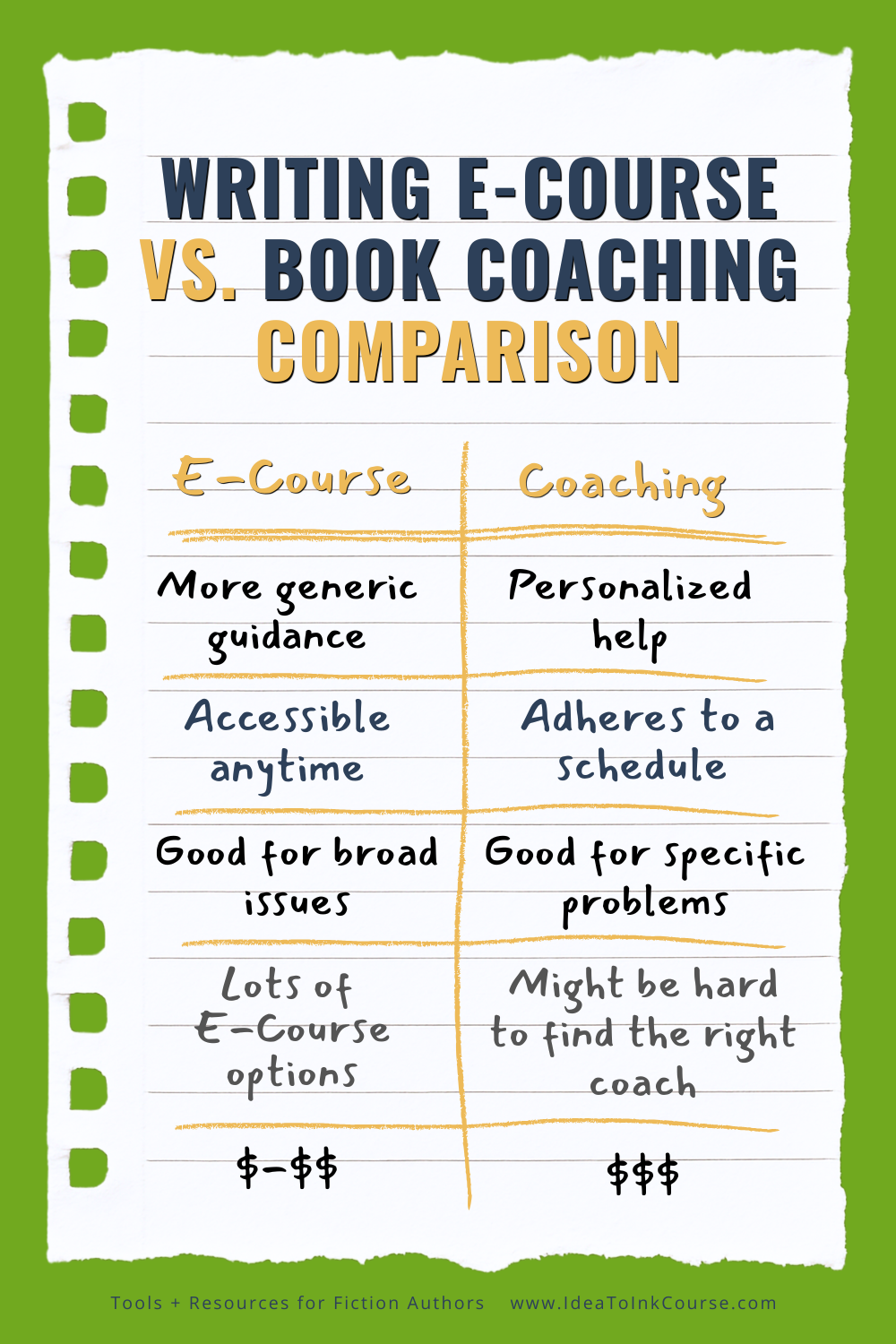
Writing Course Versus Coaching: Compare Your Needs
The simplest way to choose is to identify the kind of friction you are experiencing. If your friction is broad, a course is usually the answer. If it is specific, coaching may be the better fit.
For example, “I do not know how to begin a novel” is broad. A guided course can teach you how to develop an idea, create characters, plan a plot, and establish a writing practice. “I know my protagonist’s goal, but the middle of my novel goes flat” is specific. That is a useful coaching conversation.
The same distinction applies to nonfiction. “I have expertise but no clue how to organize a book” points toward a course with planning tools. “I have an outline, but I cannot decide what to cut without weakening my message” points toward coaching.
Your learning preferences matter too. Some writers enjoy working privately through prompts and lessons, then applying what they learn at their own pace. Others gain clarity by talking through decisions out loud. Neither preference is more serious or more committed. It simply tells you what kind of support will feel productive rather than draining.
Finally, consider timing. A course gives you a resource you can revisit when life gets busy. Coaching gives you concentrated support during a season when you are ready to prioritize your book. You may not need one choice forever. Many writers begin with a course, build a foundation, and add coaching later when they reach a decision point or want deeper accountability.
A Practical Way to Decide This Week
Do not wait until you feel perfectly ready. (Hint: this will never happen) Give yourself ten quiet minutes and write down your answers to three questions: What is the next milestone for my book? What is stopping me from reaching it? What kind of help would make that step feel possible?
If your answers include phrases such as “I need a plan,” “I do not know the order of the steps,” or “I need prompts to get moving,” choose a course or a structured writing kit. If they include “I need feedback on this,” “I keep going in circles,” or “I need someone to help me make a decision,” coaching may be the support that changes your pace.
You can also test the decision by choosing one small commitment. Set aside two writing sessions this week. If you cannot decide what to do in those sessions, start with structured instruction. If you know what to do but cannot move past a recurring question or block, write that question down for a coach. If you're still not sure which one you should choose, I recommend scheduling a free discovery session. This is a free, 30 minute call with me to help you figure out what resources will help best fit your needs and (this is super important) within your resources!!
At Idea to Ink, the path is designed to meet writers at different stages, from practical planning tools to guided learning and one-on-one support. The point is not to prove you can do everything alone. The point is to find the level of structure that helps you keep going.
Your book does not need a dramatic burst of inspiration to begin. It needs a next step that feels clear enough to take, then another one after that. Choose the support that helps you show up for the story, knowledge, or message only you can write.

Ready to write your book?
Download the Essential Book Writing Templates for FREE and start strong.
We think SPAM is icky. We will never sell your information, and you can unsubscribe at any time.