How to Stop Writer Overwhelm
You do not need more pressure. (Do you know any writer than needs more pressure??) You need a better writing setup.
If you have been staring at a draft, opening ten documents, changing your outline three times, and still not writing, you are not lazy and you are not failing. You are overloaded. Learning how to stop writer overwhelm starts with this shift: overwhelm is usually not a motivation problem. It is a structure problem.
That matters because most aspiring authors try to solve overwhelm by pushing harder. They wait for confidence, demand clarity before they begin, or promise themselves they will write for three hours on Saturday. Then life happens, the session feels too big, and the book starts to feel even further away.
The good news is that overwhelm is not proof that you cannot write a book. It is often a sign that your brain is carrying too many decisions at once. When you reduce the number of decisions, writing gets lighter. Progress becomes visible. And visible progress is what rebuilds confidence.
Why writer overwhelm happens in the first place
Writer overwhelm rarely comes from one thing. It usually builds from a stack of unfinished decisions.
You might be trying to figure out your idea, your structure, your opening chapter, your writing schedule, and whether the whole book is even good enough, all in the same sitting. That is an impossible workload for one writing session. Your brain does what overloaded brains do. It freezes, procrastinates, or jumps between tasks without finishing any of them.
Perfectionism also plays a role, but not always in the obvious way. Many writers think perfectionism means wanting polished sentences. Sometimes it looks more like needing the entire book plan to feel certain before you draft a single page. That kind of certainty is tempting, but writing rarely works that way. Some clarity only shows up after motion starts.
There is also an emotional layer. If the book matters to you, the stakes feel high. You are not just writing words. You are trying to say something meaningful, prove something to yourself, or finally finish the project you have carried for years. That emotional weight can make even a small writing task feel huge.
How to stop writer overwhelm by shrinking the task
The fastest way to lower overwhelm is to stop treating writing as one giant activity.
"Work on my book" is too broad for your brain to trust. It sounds endless. A smaller task creates a starting point. Instead of planning to write chapter one, plan to draft the scene where your character misses the train. Instead of revising your introduction, rewrite only the first two paragraphs for clarity. Instead of outlining the whole book, list five possible chapter topics.
Specificity calms the mind because it gives your session edges.
This is where many writers hesitate. Small tasks can feel too small, almost childish, compared to the seriousness of writing a book. But small is not unserious. Small is what gets done. And what gets done is what builds a manuscript.
If you are overwhelmed right now, your only job is to define the next visible step. Not the next ten. Just the next one.
Build a writing process that makes decisions ahead of time
A consistent process is one of the most effective answers to how to stop writer overwhelm, because it removes the need to reinvent your approach every time you sit down.
You do not need a complicated system. You need a repeatable one.
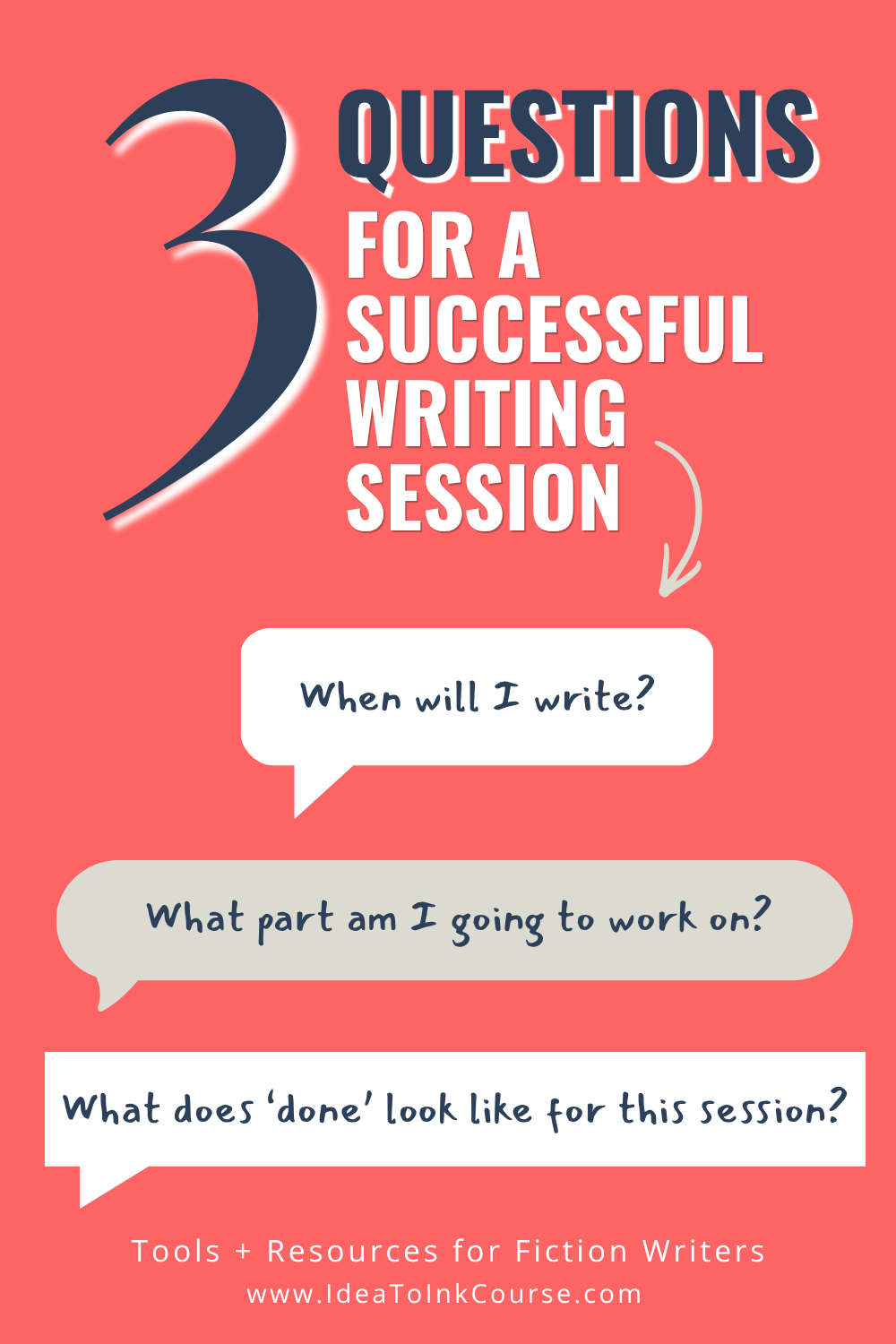
At a minimum, decide three things before your writing week starts: when you will write, what part you will work on, and what “done” means for that session. When those decisions are made in advance, you spend less energy negotiating with yourself in the moment.
For example, a writing block might be Tuesday at 7:00 p.m., working on one scene, with a goal of 400 rough words. That session has a time, a target, and a finish line. Compare that with sitting down and asking, “What should I do tonight?” That question sounds harmless, but it opens the door to delay.
This is one reason structured tools help beginners so much. A worksheet, prompt, or chapter plan is not there to limit your creativity. It is there to reduce friction. Our Idea to Ink Course is built on that principle for a reason: writers move faster when the path is clearer.
Separate drafting from deciding
One of the biggest causes of overwhelm is mixing different kinds of work together.
Drafting, researching, organizing, and editing all use different mental gears. When you try to do them at once, your progress slows and your frustration rises. You write a paragraph, stop to look something up, question your structure, reread what you wrote, decide it is bad, and lose momentum.
A better approach is to assign one job to each session.
If today is a drafting session, draft. Leave notes in brackets when you hit a gap. If today is a planning session, plan. If today is a revision session, revise only the pages you already have. This sounds simple, but it changes everything because it protects your attention.
It also makes sessions easier to begin. Your brain can handle one mode at a time. It struggles when asked to create, judge, and solve every problem simultaneously.

Use time limits when the work feels emotionally heavy
Some writing tasks feel overwhelming not because they are technically difficult, but because they carry emotional resistance. Maybe it is the first chapter. Maybe it is a personal story. Maybe it is the chapter you have avoided for months.
When a task feels loaded, a word-count goal can backfire. It may feel like one more standard you have to meet. In those moments, use a time limit instead.
Tell yourself you are writing for 15 minutes. Not forever. Not until it is good. Just 15 minutes.
This works because time-based writing lowers the emotional price of starting. Most resistant tasks become more manageable once you are in motion. And if 15 minutes is all you do, that still counts. A short session completed is far more useful than a perfect session postponed.
Watch for the hidden habits that create more overwhelm
Sometimes overwhelm is not coming from the book itself. It is coming from the way you approach your writing life.
Too many resources can be a problem. If you are consuming endless advice, switching methods every week, and collecting templates without using them, you may be feeding confusion instead of reducing it. Guidance is helpful. Constant input is not. Choose one resource and stick with it.
Comparison creates a similar trap. If you keep measuring your early draft against someone else’s published book, your work will always feel behind. The fix is not to stop caring about quality. It is to compare your draft only to the stage it is actually in.
Overplanning can also become avoidance. Planning is useful when it leads to action. If it keeps replacing action, it may be giving you the feeling of productivity without the progress. It depends on the writer, of course. Some people need a stronger outline before drafting. Others need to draft sooner to discover the shape. The key is honesty about whether your preparation is moving the book forward.
Create a reset plan for overwhelmed days
Even with a good system, some days will still feel messy. That does not mean your process is broken. It means you are human.
What helps is having a reset plan ready before you need it. On overwhelmed days, do not ask yourself to rescue the whole project. Return to a basic sequence.
First, open one document only. Second, write down the single task that matters most. Third, set a short timer. Fourth, stop when the timer ends and decide your next step before closing the file.
That last part matters. Leaving yourself a note like “next, draft the argument in section two” makes tomorrow easier. You are handing your future self a starting point instead of a blank page.
Let progress be enough for now
Many aspiring authors stay overwhelmed because they think the cure is feeling fully ready. Usually, the cure is building enough structure to keep going before you feel fully ready.
You do not need the perfect writing routine, the perfect outline, or the perfect level of confidence. You need a process simple enough to repeat. The more repeatable it is, the less dramatic writing becomes. And that is a good thing. Books are not usually written in grand bursts of certainty. They are written in steady returns.
So if your book feels too big today, make it smaller. If your sessions feel chaotic, define them more clearly. If your brain is carrying too many decisions, make some of them in advance. That is how writing starts to feel possible again.
Your next step does not need to be impressive. It just needs to be clear enough to do.

Ready to write your book?
Download the Essential Book Writing Templates for FREE and start strong.
We hate SPAM. We will never sell your information, for any reason.