How to Finish First Draft Without Stalling
You do not need more talent, a better routine, or a sudden burst of inspiration to learn how to finish first draft. You need a system that keeps you moving when the writing feels messy, uncertain, or flat. Most writers do not stop because they have nothing to say. They stop because they lose the path halfway through.
That is good news, because a lost path can be rebuilt.
Why finishing a first draft feels so hard
A first draft asks you to do two jobs at once. You are trying to create something meaningful while also tolerating the fact that it will be incomplete, uneven, and sometimes disappointing. For new writers, that tension can feel like proof that something is wrong. It is not. It is part of the process.
The middle of a book is where many writers get stuck. The excitement of starting has worn off, but the clarity of the ending is not fully in reach yet. You may start questioning your idea, your voice, your structure, or whether the book matters at all. This is where unfinished drafts pile up.
The real challenge is not writing beautiful pages every day. It is staying in motion long enough to reach the end.
How to finish first draft with a clearer plan
If you want to finish, your draft needs more than enthusiasm. It needs shape. That does not mean you need a detailed scene-by-scene outline if that drains your creativity (although that has helped a lot of people!) It means you need enough structure to know what comes next.
Start by identifying three anchor points in your book: the beginning, the middle shift, and the ending. For fiction, that could mean the setup, the major turning point, and the final resolution. For nonfiction, it might be the core problem, the framework or transformation, and the result you want the reader to reach. These anchors give your draft direction even if the details change.
Then break the manuscript into small writing targets. Think in terms of chapters, scenes, or sections, not the whole book. “Write my novel” is too big for your brain to trust. “Draft chapter three by Friday” is concrete enough to act on.
A useful plan is one you can actually follow on a tired Tuesday. If your writing schedule only works under perfect conditions, it is not a writing plan. It is wishful thinking.
Set a pace that matches your real life
A common mistake is choosing a goal based on urgency instead of capacity. Writing 2,000 words a day sounds exciting until your job, family, energy, or attention span makes that pace impossible. Missing the goal for a few days can quickly turn into shame, and shame is terrible fuel.
Pick a pace you can repeat. For some writers, that means 300 words a day. For others, it means two focused sessions a week. Consistency matters more than intensity because it keeps your book alive in your mind.
If you have an ambitious season with plenty of time, great. Use it. But build your baseline around your normal life, not your ideal week.
Decide what counts as done for each session
One reason writers drift is that they sit down without a finish line. They tell themselves to work on the book, then spend forty minutes rereading old pages, changing a sentence, and wondering why they still feel behind.
Before each session, choose one clear objective. Draft the opening of a chapter. Write the argument for section two. Get your main character from the argument with her sister to the scene at the airport. A session with a target is much easier to complete than a session built on vague effort.
Stop editing while you draft
If you are serious about how to finish first draft, this is the rule that will save you the most time: drafting and editing are different tasks. When you mix them, your progress slows to a crawl.
Revision asks, “How can this be better?” Drafting asks, “What happens next?” Both questions matter, but not at the same time.
It is tempting to polish early chapters because they are visible. They feel fixable. The unwritten parts of your book feel uncertain, so your brain tries to hide in cleanup work. That can feel productive, but it often becomes avoidance.
Give yourself permission to write placeholders. Mark a weak section with a note like “add better example here” or “research this detail later,” then keep going. Your job in a first draft is not to solve every problem. Your job is to build a complete draft you can improve.
Expect the messy middle and plan for it
Most writers think getting stuck means they are off track. Usually, it means they have reached the part of the process where the original idea must become an actual book.
The messy middle often happens for one of three reasons. Either the structure is too loose, the stakes are unclear, or you have been trying to write from a vague feeling instead of a specific next step. The fix is not always more motivation. Often, it is more clarity.
When you stall, pause and ask a simple question: what is this chapter or section doing? If you cannot answer that, the problem is probably structural. The section may need a clearer purpose, a sharper conflict, or a stronger takeaway.
Sometimes you also need to lower the pressure. Not every chapter will feel brilliant. Some chapters exist to connect ideas, move the story forward, or set up something stronger later. They still matter.

Build a process that reduces resistance
Willpower is unreliable. A writing process works best when it removes friction before you begin.
Choose a writing time that you can protect most days of the week. Prepare your document, notes, and last sentence from the previous session so you can start quickly. End each writing block by leaving yourself a note about what comes next. That small habit can make the next session much easier because you are not starting from zero.
You also need to notice what regularly knocks you off course. For some writers, it is social media. For others, it is waiting until they have a long block of uninterrupted time. If your pattern is to postpone writing until conditions are perfect, your draft will stay unfinished for a long time.
A modest, repeatable routine will outperform a dramatic but inconsistent one almost every time.
How to finish first draft when self-doubt shows up
Self-doubt does not mean you are writing the wrong book. It usually means you care. The problem starts when doubt begins making decisions for you.
You may think, “This is too obvious,” “Someone else has said this better,” or “I am not doing this idea justice.” Those thoughts can feel final, but they are often temporary reactions to the discomfort of making something real.
Instead of asking whether the draft is good, ask whether it is moving. That is a better first-draft question. Quality matters later. Forward motion matters now.
It can also help to separate your identity from the page in front of you. A rough chapter is not evidence that you are a weak writer. It is evidence that you are in the middle of writing. There is a difference.
If you need support, use it. A writing coach, a clear framework, or an accountability check-in can keep you from turning a normal hard week into a months-long stop. This is one reason so many writers do better with guided structure. At Idea to Ink, that kind of support is built into the process because encouragement works best when it is paired with a plan.
Finish before you judge
Many drafts fail because the writer starts evaluating the whole book before the whole book exists. You cannot accurately assess pacing, clarity, emotional arc, or chapter balance from page 47. You are still inside the construction zone.
Try making one agreement with yourself: I will not decide whether this book works until I have reached the end. That single rule can protect your momentum.
You are allowed to write a first draft that is clumsy in places, repetitive in others, and missing pieces you will need to add later. That is not failure. That is raw material.
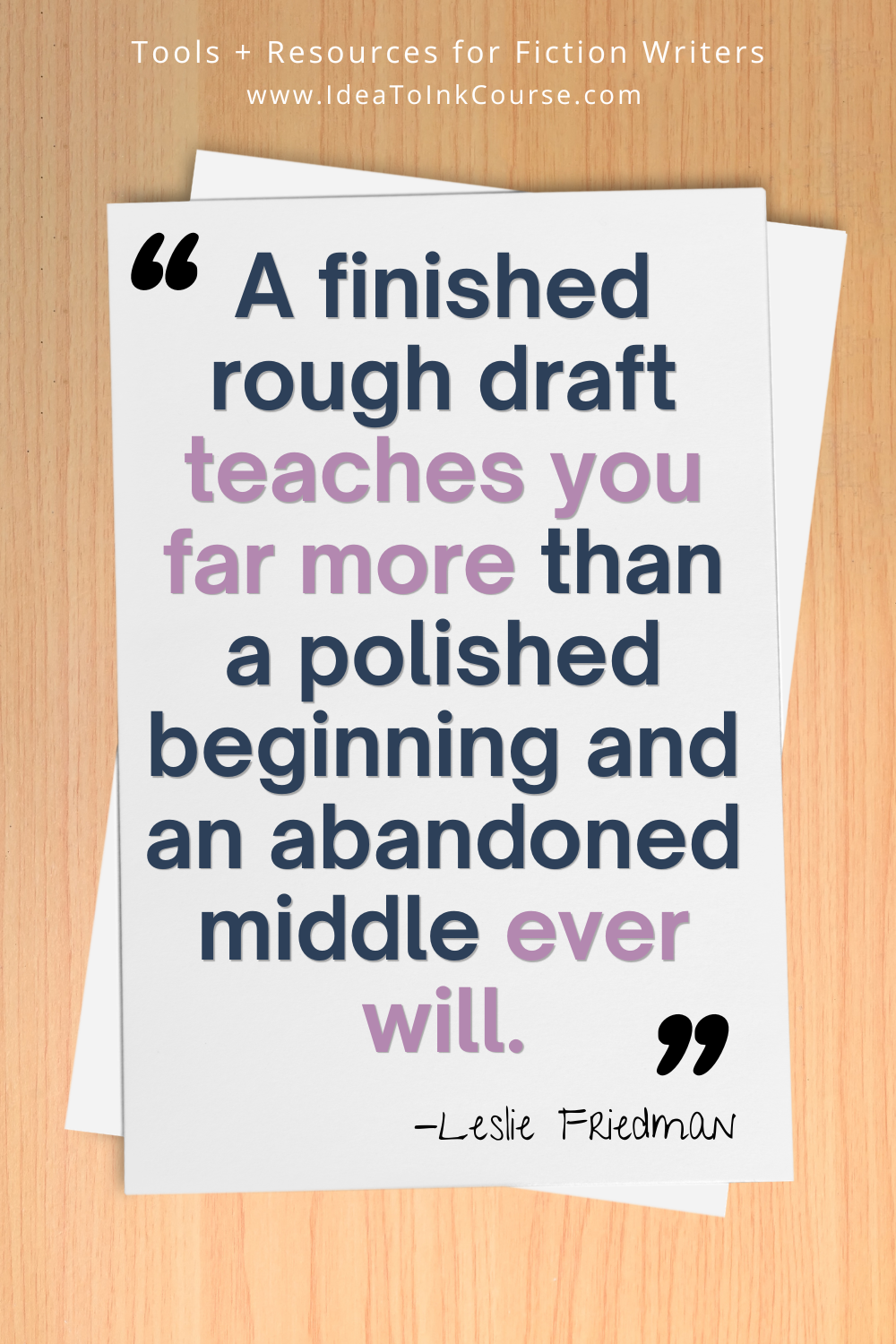
A finished rough draft teaches you far more than a polished beginning and an abandoned middle ever will.
The last pages count more than perfect pages
As you get close to the end, there can be a strange temptation to slow down. Finishing makes the draft real. It also means you will have to face revision, and that can feel vulnerable. But the final stretch is where your confidence grows.
When you complete a first draft, you stop being someone who wants to write a book and become someone who has written one. Even if it needs major revision, you have crossed the line that keeps many aspiring authors stuck for years.
So if your draft feels awkward, keep going. If your middle chapters feel uneven, keep going. If you are tired of your own book and convinced every other writer has an easier process, keep going.
The goal is not to finish with perfection. The goal is to finish with something true enough, solid enough, and complete enough to shape into the book you meant to write.
Your first draft does not need your brilliance every day. It needs your return.

Ready to write your book?
Download the Essential Book Writing Templates for FREE and start strong.
We hate SPAM. We will never sell your information, for any reason.