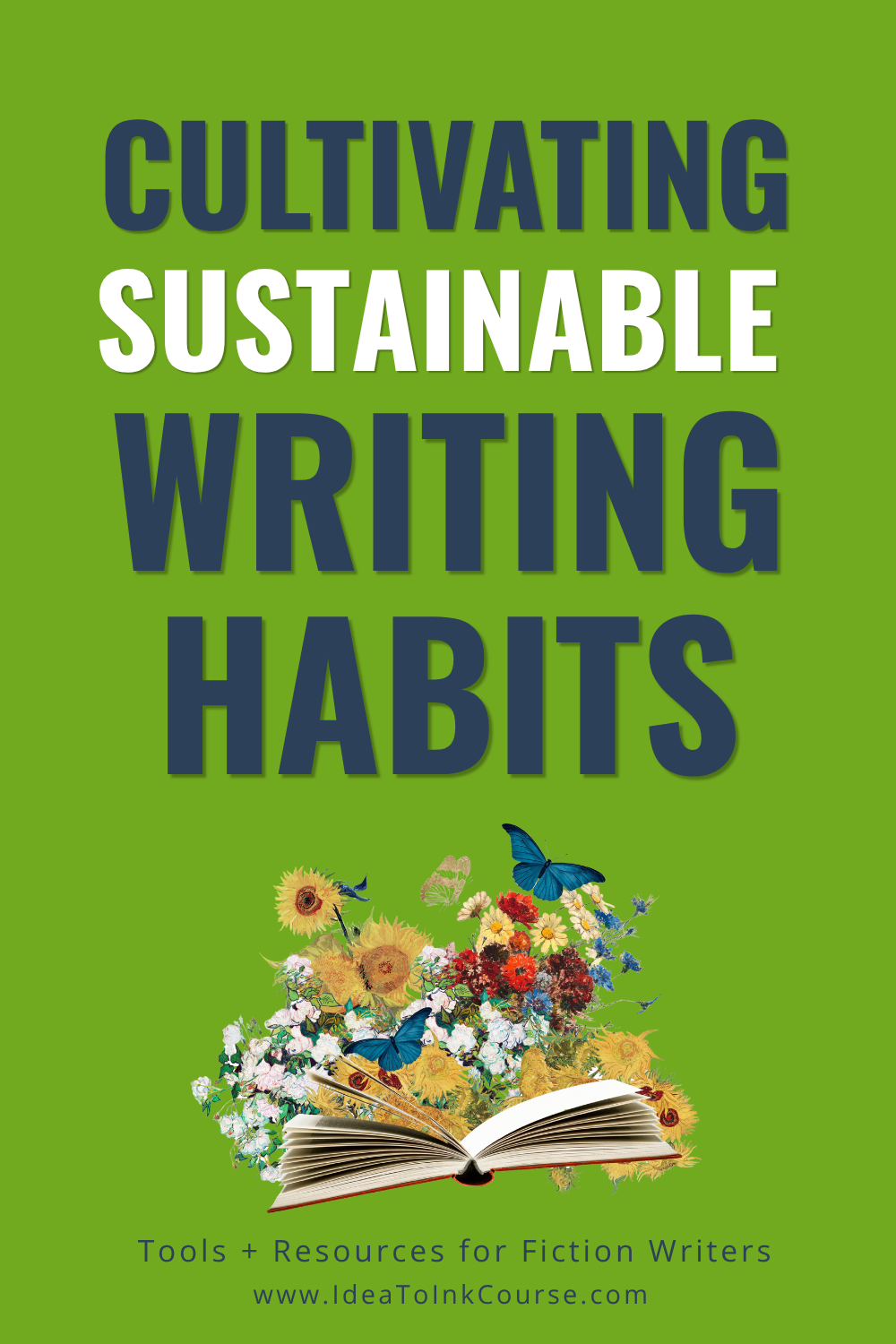
Cultivating Sustainable Writing Habits
The Real Reason Writing Habits Stick (and Why So Many Don’t)
If you’ve ever tried to build a consistent writing habit, you already know the truth. It’s not about motivation. It’s not about inspiration. And it’s definitely not about waiting for that perfect moment when your brain finally feels ready to write. Sustainable writing habits come from something much deeper, and much more human.
Let’s pause for a minute. What do I mean by sustainable writing habits? I mean finding the time and energy to show up and write on a consistent basis. I recently talked to a fellow writer who completed a different writing prompt every day for a year. That’s 365 days. That’s more than just writing on a whim of inspiration. And it may be surprising to know that it’s also more than just self‑discipline.
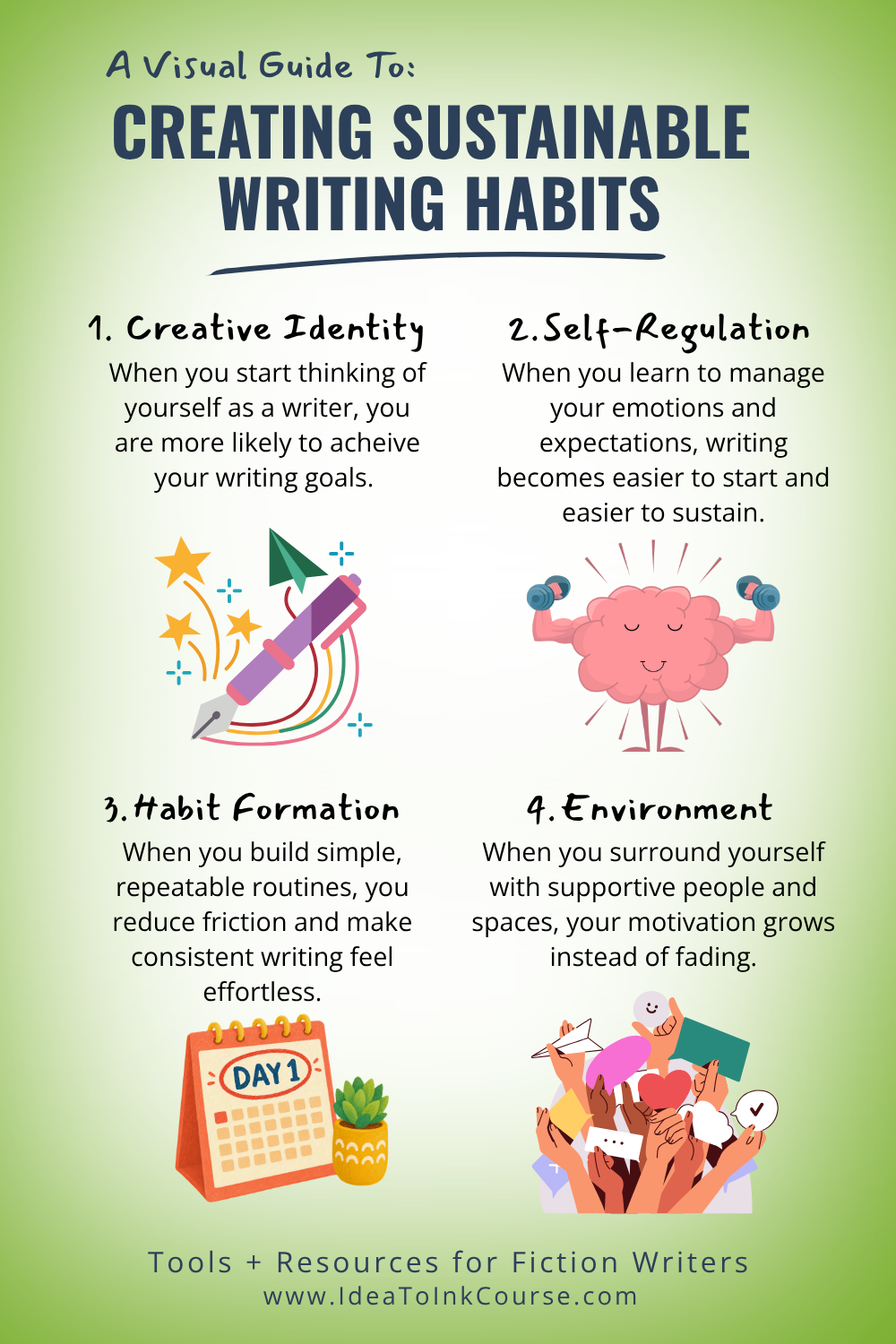
After months of digging through research on psychology, creativity studies, writing pedagogy, and habit science, one thing became clear: writing habits don’t stand on their own. They grow from the combination of four interconnected elements: identity, self‑regulation, habits, and environment.
And the best way to understand this is to think of writing like a garden.
Identity: Seeing Yourself as the Gardener
Identity is the foundation of every sustainable writing habit. Research in creative writing pedagogy shows that when writers see themselves as writers, they write more. Identity‑based habits stick; task‑based habits fade.
This seems really obvious, but I was honestly surprised to see this come up again and again in research. It makes sense, but we tend to overlook identity because it’s a tricky thing and looking in the mirror and declaring, “I am a writer!” every morning is not exactly an easy sell.
But it makes a lot more sense when you think of it in garden terms: identity is seeing yourself as the gardener, aka: the person who has the power to grow the flowers. If you don’t believe you’re a gardener, you won’t pick up the watering can. You won’t plant the seeds. You won’t tend the soil. You won’t show up consistently.
When you believe you’re a writer, your brain starts making decisions that align with that identity. You protect your writing time. You take your ideas seriously. You show up even when it’s hard.
Identity is the invisible yet vital engine behind every sustainable writing habit.
Self‑Regulation: Filling the Watering Can
Self‑what? I kept reading about “creative self‑regulation” in the research, and technically I knew what those words meant, but I still had no idea what it actually meant. If someone were to ask me what creative self‑regulation was, I would have no idea how to explain it. As it turns out, it’s something that (much like identity) plays a very important role in shaping your life as a writer.
Self‑regulation is the ability to manage yourself through the messy middle: the part of writing where things feel uncertain, emotional, nonlinear, and sometimes downright chaotic. Research by Ivcevic and Nusbaum shows that creativity isn’t just about generating ideas; it’s navigating the emotional and cognitive complexity of making something.
Self‑regulation includes:
- adjusting expectations
- managing emotions
- persisting through obstacles
- revising your approach when things don’t work
Let’s go back to our garden analogy. In garden terms: self‑regulation is filling the watering can with the right amount of water. It’s choosing how you’ll show up. It’s managing your energy. It’s deciding what to do when things don’t go as planned. How much water should you put in the can? How heavy can you make the watering can before it becomes too much to carry? What happens if the watering can has a leak or your water source runs dry?
Most writing advice skips this part entirely. But behind the scenes, writers talk constantly about the emotional strain of imposter syndrome, perfectionism, and uncertainty. Self‑regulation is how you keep going anyway.
Habits: Watering the Plants
Habit research tells us that simple habits run automatically, but complex habits (like writing a novel!) always require deliberate effort. Even when writing becomes a habit, it still asks something of you. And that’s normal. It even requires an effort from someone like Stephen King that has done this five million times (give or take).
Habits reduce mental strain by taking care of predictable tasks: your warm‑up ritual, your writing time, your notebook, and your digital setup. They make writing easier to start, easier to continue, and easier to return to after a break.
In garden terms: habits are the act of watering the plants every day. Not perfectly. Not for hours. Just consistently, over and over again.
A lot of people feel that habits are stifling and that they are the enemy of creativity. This isn’t true. Habit is the foundation that makes creativity possible. If you don’t show up to water every day, the chance of your flowers blooming is slim.
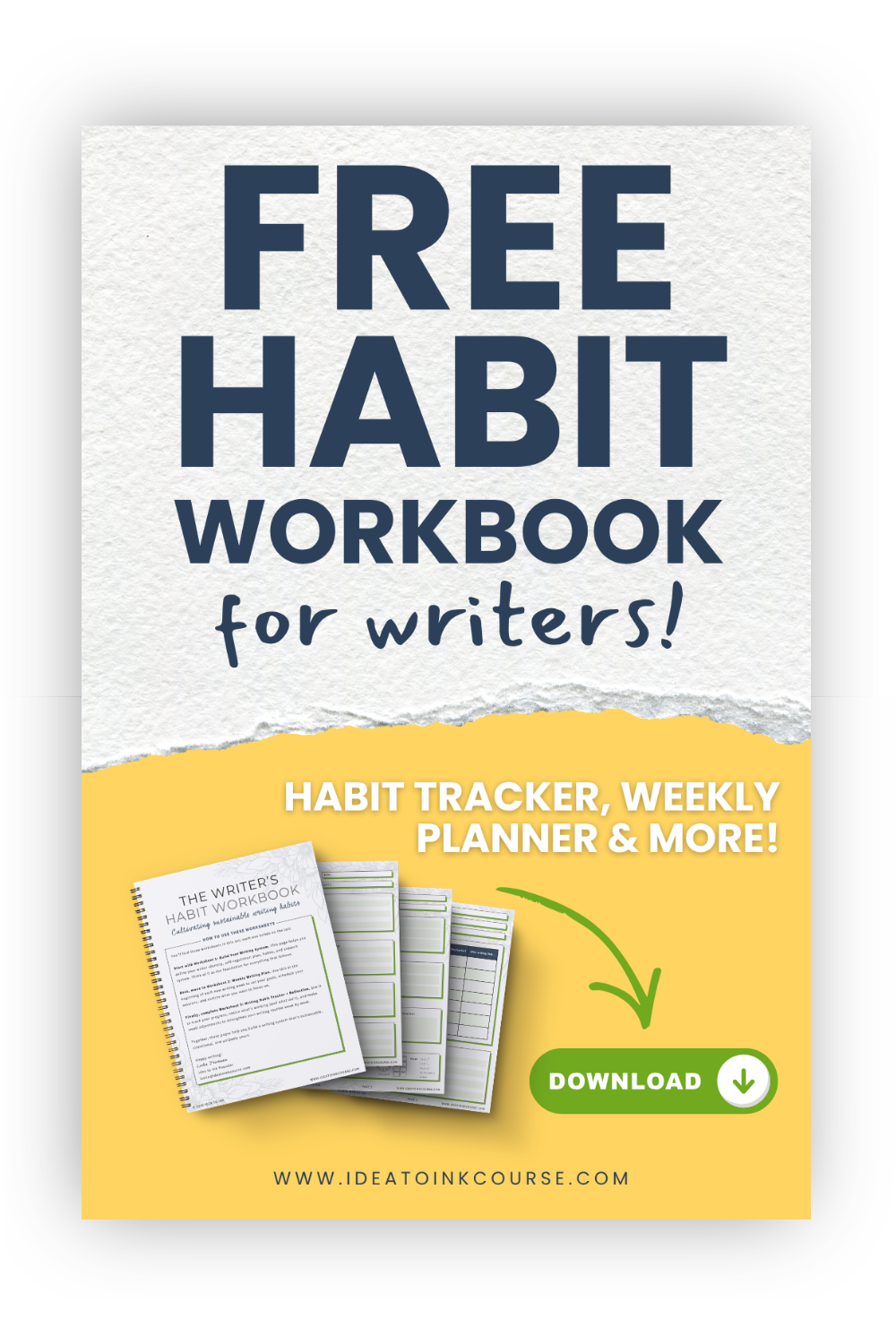
Hint: Looking for a way to set and track your habits? Check out our free Habit Workbook for Writers instant download!
Environment: The Soil Where the Plants Grow
Motivation research shows that motivation isn’t purely internal; it’s environmental. This is a huge shift from the old belief that motivation is a personality trait; that you are either a motivated person or you’re not. That idea is false. Motivation is a context.
Writers thrive when they feel empowered, connected, and supported. Community, autonomy, and low‑stakes spaces make writing feel safer and more doable.
Going back to our garden: environment is the soil, the sunlight, and the space where the plants actually grow. You can water a plant faithfully, but if the soil is wrong, the plant won’t thrive.
This is why writing groups, coworking sessions, retreats, and supportive communities work so well. They create the conditions where motivation can grow. When you write in isolation, motivation has to come entirely from within. When you write in community, motivation is supported by your environment.
The problem is that communities can be scary, and it feels safer (at least that’s what our ego tells us) to go it alone. Because, after all, what if we share something we’re doing and people think it’s bad? Or stupid? It’s easier to keep it to ourselves until we’re “ready.”
Sure, we’ve all seen the rogue dandelion that grows in the concrete sidewalk crack. It’s determined to live. Maybe you write like that: alone, in the thick of it by yourself. But why? Why when you can grow in a field full of nutrient-rich soil? Why make things harder on yourself?
One of the hardest things for writers (and honestly, people in general) is setting your ego aside and being vulnerable. But that’s actually what makes stronger communities with better support. When you are vulnerable about your self‑regulation (“I feel like an imposter and I don’t know how to navigate that”), you actually have a better chance of successfully regulating and helping others along the way.
Environment is not optional. It’s part of the ecosystem. Are you going to choose the barren sidewalk or the lush field? It’s your choice.

Sustainable Writing Habits Are a Garden
When you combine identity, self‑regulation, habits, and environment, you get a sustainable writing ecosystem — one that grows your creativity instead of draining it.
Identity is believing you’re the gardener. Self‑regulation is filling the watering can. Habits are watering the plants. Environment is the soil where the plants grow.
Together, they create something living, resilient, and self‑supporting.
Yes, you can buy cut flowers (just like you can write only when inspiration strikes) but that isn’t sustainable if what you want is a garden. Cut flowers fade. A garden grows. A garden becomes something.
Sustainable writing habits aren’t built on discipline. They’re built on systems that:
- support your creative process
- reduce friction
- build confidence
- lower anxiety
- reinforce identity
- make writing feel safe, doable, and repeatable
This is exactly what the research shows. And it’s exactly what I teach in my Idea to Ink Writing Course.
You can build a writing habit that lasts. And you don’t have to do it alone.
Leslie Friedman
Idea to Ink Founder & Instructor

References
Camacho, A., Alves, R. A., & Boscolo, P. (2021). Writing motivation in school: A systematic review of empirical research in the early twenty‑first century. Educational Psychology Review, 33(1), 213–247.
Cheng, S., Lin, C., Wei, D., & Chen, Y. (2026). A longitudinal psychological model of writing development: Interactions among self‑efficacy, regulation, and anxiety. Frontiers in Psychology, 17. https://doi.org/10.3389/fpsyg.2026.1757045
Dorina, I., Mullan, B., & Boyes, M. (2026). Clarifying the importance and moderating roles of temporal self‑regulation theory across behaviour types. Psychology & Health, 41(3), 287–305. https://doi.org/10.1080/08870446.2024.2422828
Göçen, G., Demirtaş Tolaman, T., & Azizoglu, N. I. (2023). Using technology to support creative writing: How it affects teachers’ digital writing skills and their gains from digital technology. International Journal of Psychology and Educational Studies, 10(2), 422–440.
Ivcevic, Z., & Nusbaum, E. C. (2017). From having an idea to doing something with it: Self‑regulation for creativity. In The Creative Self (pp. 343–365). Elsevier. https://doi.org/10.1016/B978‑0‑12‑809790‑8.00020‑0
Myhill, D., Cremin, T., & Oliver, L. (2023). The impact of a changed writing environment on students’ motivation to write. Frontiers in Psychology, 14. https://doi.org/10.3389/fpsyg.2023.1212940
Nguyen, T. L., & Prabhu, R. (2025). The ACT‑ON Ideas framework: A contingency perspective on creative self‑regulation. Journal of Creative Behavior, 59(1), 1–14.
Ross, W., & Glaveanu, V. (2025). The constraints of habit: Craft, repetition, and creativity. Phenomenology and the Cognitive Sciences, 24(1), 251–271. https://doi.org/10.1007/s11097‑023‑09902‑5
Saunders, B., & More, K. R. (2025). Some habits are more work than others: Deliberate self‑regulation strategy use increases with behavioral complexity, even for established habits. Journal of Personality, 93(2), 233–246.
Ready to write your book?
Download the Essential Book Writing Templates for FREE and start strong.
We hate SPAM. We will never sell your information, for any reason.