How to Turn Notes Into Chapters
You do not need more notes. You need a way to shape the notes you already have into something a reader can follow. If you have pages of ideas, scenes, research, memories, or voice memos and you are wondering how to turn notes into chapters, the shift is usually not about writing faster. It is about giving your material a job.
That can feel surprisingly emotional. Notes are private. Chapters are decisions. The moment you start building chapters, you are no longer collecting possibilities...you are choosing a path. That is why so many writers stay in note-taking mode for months or years. It feels productive, but it keeps the real draft at a safe distance.
The good news is that chapters do not begin as polished units. They begin as containers. Once you treat each chapter like a container with a purpose, your notes stop looking random and start looking usable.
How to turn notes into chapters without forcing it
A chapter is not just a pile of related points. It needs movement. Even in nonfiction, a chapter should take the reader from one place to another. In fiction, that movement might be emotional, dramatic, or plot-based. In nonfiction, it might be conceptual, practical, or transformational. Either way, a chapter works because it creates change.
So before you sort your notes, ask a better question than what goes together. Ask what changes here.
Maybe your notes describe a moment when your character realizes she cannot stay silent anymore. That is a chapter because something shifts. Maybe your nonfiction notes explain why the reader has been stuck, then introduce a new framework for moving forward. That is also a chapter because the reader ends in a different mindset than they started.
This is where many writers get stuck. They try to organize by topic too early. Topic matters, but chaptering is really about progression. If your notes are grouped only by theme, you may end up with chapters that feel static, repetitive, or overloaded.
Start by sorting your notes into story or teaching moves
Before you write chapter titles, sort your notes into broad moves. Think of these as the major steps in the reader's journey.
For fiction, your moves may sound like setup, disruption, escalation, decision, consequence, or revelation. For nonfiction, they may sound like problem, insight, method, application, and next step. You are not trying to create a perfect outline yet. You are trying to identify what kind of work each section of your book needs to do.
Read through your notes and label them loosely. A character sketch might belong to setup. A messy journal entry about burnout might belong to the problem chapter in a nonfiction book. A research note about communication styles might support a chapter on conflict, boundaries, or personal growth depending on the promise of your book.
Some notes will fit in more than one place. That is normal. Put them where they serve the strongest change. If a note is interesting but does not help the reader or story move forward, set it aside. Not every note earns a chapter.
This step matters because it turns a chaotic archive into grouped material. You are building order before you build prose.
Build each chapter around one clear job
Once your notes are loosely sorted, give each potential chapter a job description.
This can be as simple as one sentence:
This chapter shows why the main character leaves home.
This chapter helps the reader understand the real reason they procrastinate.
This chapter raises the cost of avoiding the truth.
This chapter teaches the first step of the method.
If you cannot describe the chapter's job in one sentence, the chapter is probably trying to do too much. That is a useful signal, not a failure. It means you may need to split the material or decide which idea matters most.
Writers often assume chapters need to be long to be meaningful. They do not. A strong chapter is unified, not bloated. If your notes cover three emotional turns, two timelines, and a pile of backstory, you may be looking at three chapters, not one.
The opposite problem happens too. Sometimes writers create a separate chapter for every small note, which leads to a fragmented draft with no momentum. If several notes contribute to the same shift, they probably belong together.
A practical test helps here: if you removed this chapter, what would the reader lose? If the answer is clarity, motivation, context, or a major turn, the chapter has a job. If the answer is mostly extra detail, the material may belong inside another chapter or in your cut file.
How to turn notes into chapters with a simple chapter map
Now give each chapter a basic internal structure. This is the part that helps notes become draftable.
You do not need a detailed scene-by-scene plan unless that works for you. Most early-stage writers do better with a short chapter map that answers four questions: where does the chapter begin, what tension or question carries it, what key point or event happens, and where does the chapter leave the reader?
For fiction, that may look like this in plain language: your character starts defensive, faces pressure from another character, reveals something she did not mean to reveal, and ends the chapter more exposed than before.
For nonfiction, it may look like this: the reader starts confused about why they are stuck, sees a pattern they had not noticed, learns a framework for naming the issue, and leaves with a small action to try.
This matters because notes are usually fragments. A chapter map gives those fragments sequence. Instead of staring at fifteen disconnected notes, you can place each one where it belongs in the flow.
A lot of overwhelm disappears once you stop asking, How do I write this whole chapter? and start asking, What note helps me open? What note raises the tension? What note delivers the turn? What note helps me close?

Fill the gaps between notes instead of waiting for inspiration
Your notes are not supposed to contain the whole chapter. They are raw material, not finished architecture.
Many writers think they are not ready to draft because their notes feel thin in certain places. Usually, what is missing is not brilliance. It is connective tissue. You may need a transition, an example, a reflection, a scene beat, or a short explanation that links one note to the next.
This is where drafting becomes active thinking. You are not copying notes into a document. You are building the bridge between them.
If a chapter feels jumpy, look for the missing middle. If it feels flat, look for the missing stake. If it feels overloaded, look for the idea that belongs elsewhere.
There is no shame in discovering you need more material. But gather with intention. Do not go back into endless note-taking. Ask a focused question, collect only what answers it, and return to the chapter.
Let chapter titles stay temporary for a while
Writers sometimes freeze because they think chapter titles or order need to be final before drafting. They do not.
Use working titles that describe function, not polish. Chapter 3 might simply be The Argument That Changes Everything or Why the Reader Still Feels Stuck. Useful titles keep you oriented. Fancy titles can come later.
The same goes for order. You may discover that two chapters need to switch places once you start writing. That is not lost work. It is part of understanding your book more clearly.
Structure should support momentum, not become another perfection trap.
When your notes are messy, choose progress over elegance
Some note collections are neat. Most are not. They are half-thoughts in notebooks, screenshots, sticky notes, phone recordings, and scraps of sentences written at red lights or in bed. You can still build chapters from that.
Start with one chapter, not the whole book. Gather only the notes that seem related to one meaningful shift. Give that chapter a job. Map its beginning, middle, and end. Draft from there.
This is one reason structured support works so well for new writers. A clear framework reduces the emotional weight of every decision. At Idea to Ink, that structure is part of the point: writing becomes much less intimidating when you stop treating the book as one enormous task and start treating it as a series of smaller, teachable moves.
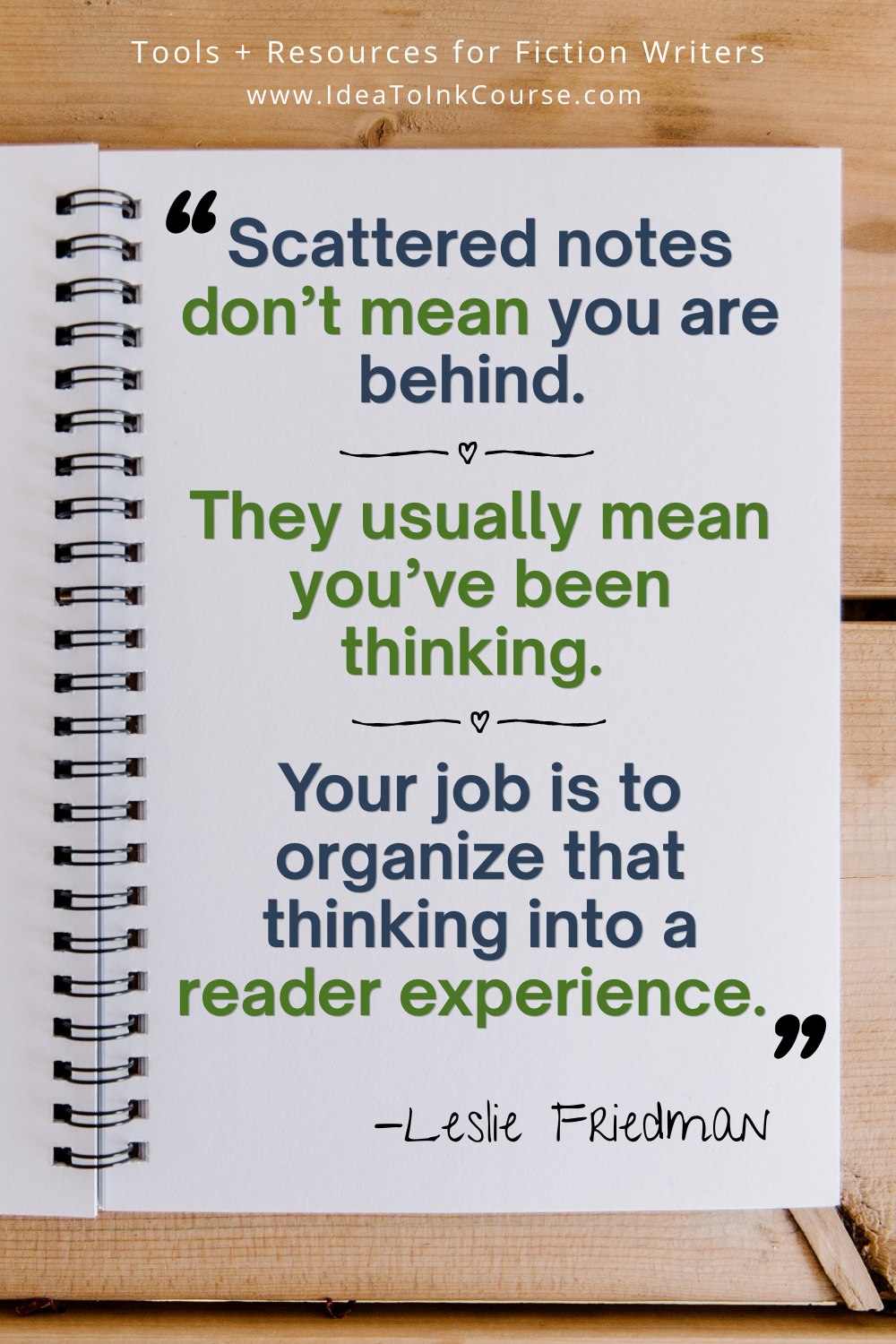
If you are worried your notes are too scattered, remember this: scattered notes do not mean you are behind. They usually mean you have been thinking. Your job now is to organize that thinking into a reader experience.
A chapter is simply a unit of change. When you know what changes, your notes have somewhere to go.
So, pick one chapter-sized shift today. Not the entire outline. Not the perfect draft. Just one shift. Name its job, gather the notes that belong to it, and write the version you can write now. Clarity often arrives after movement, not before.
Ready to write your book?
Download the Essential Book Writing Templates for FREE and start strong.
We hate SPAM. We will never sell your information, for any reason.