How to Draft Without Overthinking
You sit down to write a chapter, and ten minutes later you are still adjusting the first sentence. Then you question the scene, the character choice, the timeline, and whether the whole book idea is strong enough to continue. If you are trying to learn how to draft without overthinking, the problem usually is not a lack of talent. It is a lack of boundaries for the drafting stage.
Many aspiring authors treat drafting and editing like they are the same job. They are not. Drafting is for movement. Editing is for judgment. When those two modes blur together, your brain starts trying to solve every problem before the story has room to exist.
The good news is that overthinking is not a personality trait you have to work around forever. It is often a process issue, which means it can be changed. Once you give your draft a clearer structure, you can stop asking your first pages to do the work of a finished book.
Why writers overthink the draft
Overthinking usually looks like perfectionism, but underneath it there is often something more practical. You may not know what belongs in this chapter yet. You may not trust yourself to fix problems later. You may be drafting without a plan, so every paragraph feels like a high-stakes decision.
That matters because your brain responds to uncertainty by slowing down. If you are deciding tone, plot, pacing, character motivation, and sentence quality all at once, drafting starts to feel heavier than it needs to be.
For beginner writers especially, overthinking can also come from pressure. You do not just want to write a page. You want to prove to yourself that you really are a writer and that this book is worth finishing. That emotional weight can make every scene feel bigger than it is.
The answer is not to care less. The answer is to separate the job into smaller, clearer parts.
How to draft without overthinking: change the job description
If you want to know how to draft without overthinking, start by giving drafting a narrower purpose. A draft is not a performance. It is evidence. It proves you are exploring the book on the page instead of trying to hold the whole thing in your head.
That shift sounds simple, but it changes how you work. Instead of asking, "Is this chapter good enough?", ask, "What does this chapter need to show?" Instead of trying to write beautifully, try to write usefully. You are building material you can shape later.
A strong draft often begins with lower expectations and stronger constraints. That means deciding in advance what success looks like for today. Maybe it is 500 words. Maybe it is one scene with a clear conflict. Maybe it is getting from point A to point B without stopping to polish. The smaller and more specific the target, the less room your brain has to spiral.
Use a pre-draft plan that is simple enough to follow
Writers who overthink often benefit from more structure, not less. That does not mean you need a detailed outline with every beat locked in. It means you need enough direction to reduce decision fatigue. (Not sure where to start? Try our free fiction novel writing templates)
Before you draft, take five minutes to answer three questions: What happens in this scene or section? Why does it matter? What changes by the end? That tiny framework gives you a path forward. It also helps you avoid drifting into pages that feel busy but do not move the book.
If you are writing fiction, you might sketch the goal, the obstacle, and the shift. If you are writing nonfiction, you might define the point, the example, and the takeaway. Either way, the goal is the same. You are not planning everything. You are giving yourself a lane.
This is one reason structured writing support helps so many new authors. A worksheet, prompt, or scene map reduces the number of choices you have to make in real time. That frees up mental energy for the actual writing.
Draft in layers, not all at once
One major reason writers freeze is that they expect a first draft to do too much. They want clarity, voice, pacing, depth, and polished language from the start. That is a heavy load for a rough draft.
A better approach is to draft in layers. In layer one, get the raw scene or section down. In layer two, add missing details, transitions, or emotional texture. In layer three, improve the language.
This method works because it keeps each pass focused. You are not trying to solve every problem in one sitting. You are solving the next problem.
There is a trade-off here. Layered drafting can feel messy if you like clean pages. But messy pages are often a sign that you are working honestly. Clean pages created too early can hide the fact that you never moved far enough into the draft.

Set rules that protect momentum
Overthinking thrives in open-ended writing sessions. If there is no limit, no target, and no process, your brain will keep looking for one more thing to fix before moving on.
Try giving yourself a few drafting rules. Keep them simple and specific. For example, you might decide that you cannot edit the previous paragraph until the scene is finished. You might use brackets to mark gaps instead of stopping to research. You might leave yourself notes like [better example here] or [check timeline] and keep going.
These rules matter because they reduce interruption. Every time you stop to perfect, verify, or rethink, you break the thread of the draft. The more often that happens, the harder it is to return to momentum.
A timer can help too. Twenty-five focused minutes is long enough to make progress and short enough to feel manageable. If longer sessions make you second-guess yourself, shorter sprints may give you more traction.
In our writing community, we feature zoom sessions twice a week where you are welcome to drop in and write with others for two hours. Whether you are there for two minutes or two hours, being around others who are writing helps you stay accountable and on track! (Ps. To join one of our zoom writing sessions- join the community for free here and then sign up for a session.:)
Watch for the thoughts that sound useful but are not
Overthinking often disguises itself as responsibility. It tells you that fixing this one sentence now will save time later. It tells you that you need a better title before you can continue. It tells you that if the chapter is unclear, you should stop and rethink the whole book.
Sometimes those concerns are real. Often they are simply mistimed.
When you notice that pattern, ask a better question: Does this need attention now, or does it just feel urgent now? That distinction can save hours.
If a problem truly blocks the draft, pause and solve only what is necessary to continue. If it is not blocking you, capture it in a note and move on. You are not ignoring the issue. You are assigning it to the right phase.
Build a drafting routine your brain can trust
Confidence does not usually arrive before action. It grows because of repeated action. That means one of the best ways to stop overthinking is to make drafting more familiar.
Try writing at the same time each day or attaching it to an existing habit. Keep your setup easy. Open the same document, review your quick scene plan, and begin with a sentence starter if needed. The less friction at the start, the less chance your brain has to negotiate with you.
One thing that helps me most is to end each writing session by leaving myself a note about what comes next. A simple line like next scene: she confronts him about the letter gives you an entry point for tomorrow. Starting is often the hardest part, so make the restart easier.
If consistency has been difficult, aim for repeatable rather than ambitious. Thirty minutes four times a week will do more for your draft than one intense session followed by six days of avoidance.
Let your first draft be honest, not impressive
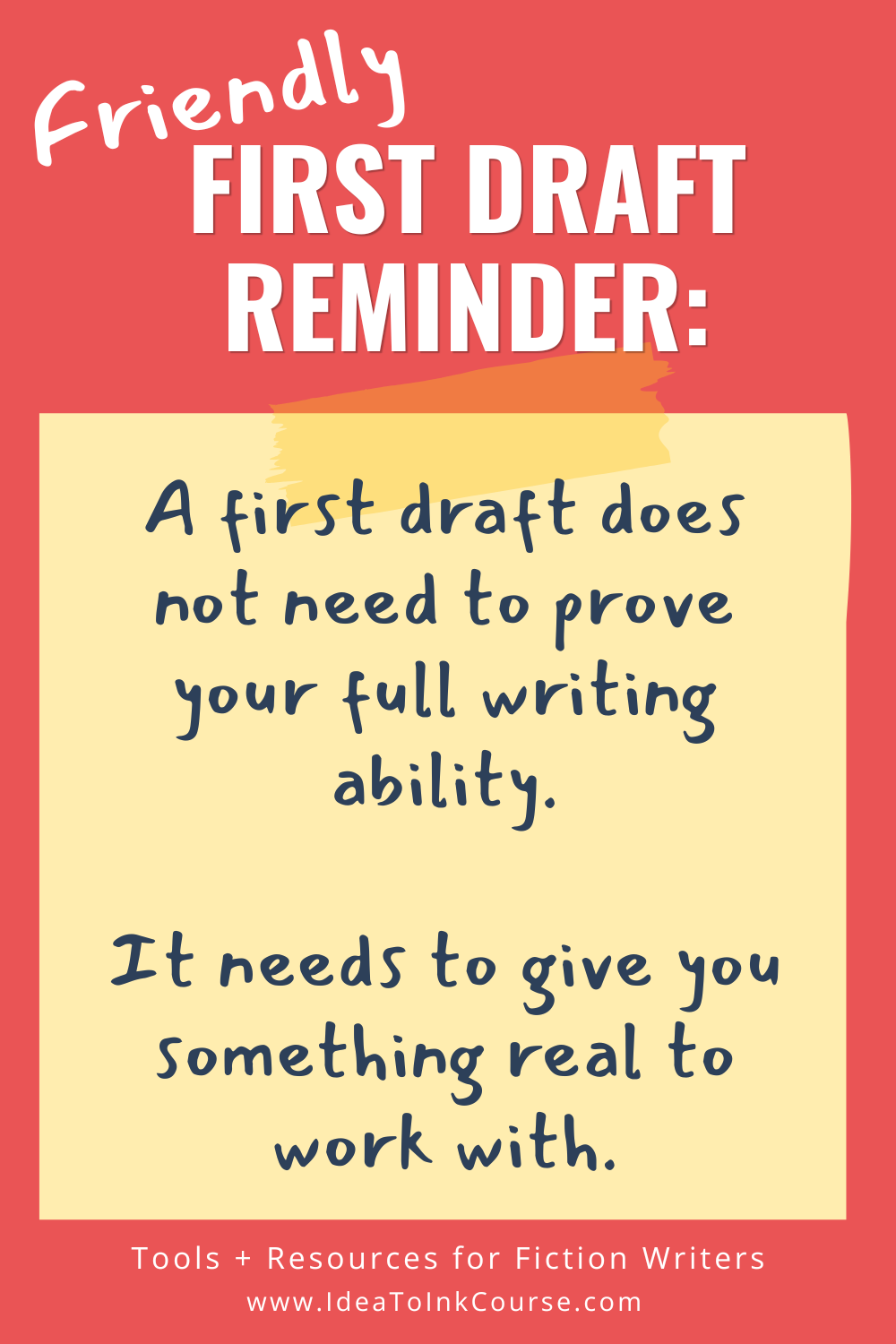
A first draft does not need to prove your full ability. It needs to give you something real to work with. Some days that will look strong. Some days it will feel awkward, obvious, or flat. That is still progress.
Writers often think overthinking comes from high standards, but sometimes it comes from fear of seeing imperfect work in black and white. That fear can keep a book trapped in your head, where it always seems more promising than it does on the page.
But books are built in the visible mess. They become clear because you draft them, not before.
If you want practical support, this is where a structured process can make a real difference. The Idea to Ink E-Course teaches writers to move from vague intention to concrete pages by breaking the work into manageable steps. That kind of support does not write the book for you. It helps you keep going when your brain wants to stall.
How to draft without overthinking when you feel stuck
If you freeze mid-draft, do not ask yourself to feel inspired. Ask yourself to make the next decision smaller. Write the scene badly on purpose. Summarize instead of dramatizing for a paragraph. Skip ahead to the part you can see. Replace a perfect sentence with a plain one that gets the meaning across.
You are allowed to write a draft that is incomplete, uneven, or clumsy. You are allowed to discover the book by writing it. In fact, many writers do their best thinking after the words exist.
The page gets lighter when you stop asking it to be finished and let it be a beginning. That is often where real momentum starts.
Ready to write your book?
Download the Essential Book Writing Templates for FREE and start strong.
We think SPAM is icky. We will never sell your information, and you can unsubscribe at any time.