Your first draft sucks. Here's why you should celebrate.
If writing a book were a play, the first draft would be the very first rehearsal—the actors stumbling over their lines, the stagehands missing their cues, and the director unsure of himself altogether. In other words, it's not graceful, it’s not refined, and it’s definitely not ready for a standing ovation.
Yet it’s in that messy chaos that the magic truly begins.
Writers often talk about their first drafts with grim determination, as though they’re entering a battlefield only armed with caffeine and willpower. But what if we stopped treating our first drafts like they are a painful rite of passage and started seeing them for what they really are: a celebration of creativity, joyful chaos, and glorious imperfection.
Yes, your first draft will be bad. No, you won’t be the exception to this rule. And that’s the beauty of it.
In this article, we’re unpacking why the first draft deserves applause (not anguish) and how you can turn your drafting sessions into a ritual of delight rather than dread.
Why “Bad” Is Actually Brilliant
Let’s get this out of the way: your first draft is going to be terrible.
It will be inconsistent.
It will be clunky.
Your characters will behave like they’re juggling multiple identities all at once.
Entire chapters may feel like the literary equivalent of oversized clown shoes.
And somehow, all of that is cause for celebration.
1) A Bad Draft Means You’re Writing
The world is full of people who “have an idea for a book.” People who talk about their future bestseller at dinner parties. People who daydream about their name glittering on the spine of a novel. People who buy fancy notebooks, expensive pens, and mood-setting candles but never produce more than a paragraph.
By writing (even badly) you have already outdone them.
A messy draft means you took action.
You sat down in front of the page.
You got creative.
You took initiative.
You created something that didn’t exist before.
That alone puts you in the minority of hopeful writers who crossed the line between dreaming and doing.
2) A First Draft Is Just Clay
Imagine trying to sculpt a statue without clay.
Ridiculous, right?
Yet writers constantly try to “sculpt” a novel out of thin air—agonizing over perfect sentences before the story even exists. Expecting a flawless first draft is unrealistic—and it stifles your creativity before it even has room to breathe.
A first draft is raw material: the lumps, bumps, and misshapen pieces that will eventually become art. It doesn’t need to be refined. It just needs to exist so you can shape it later.
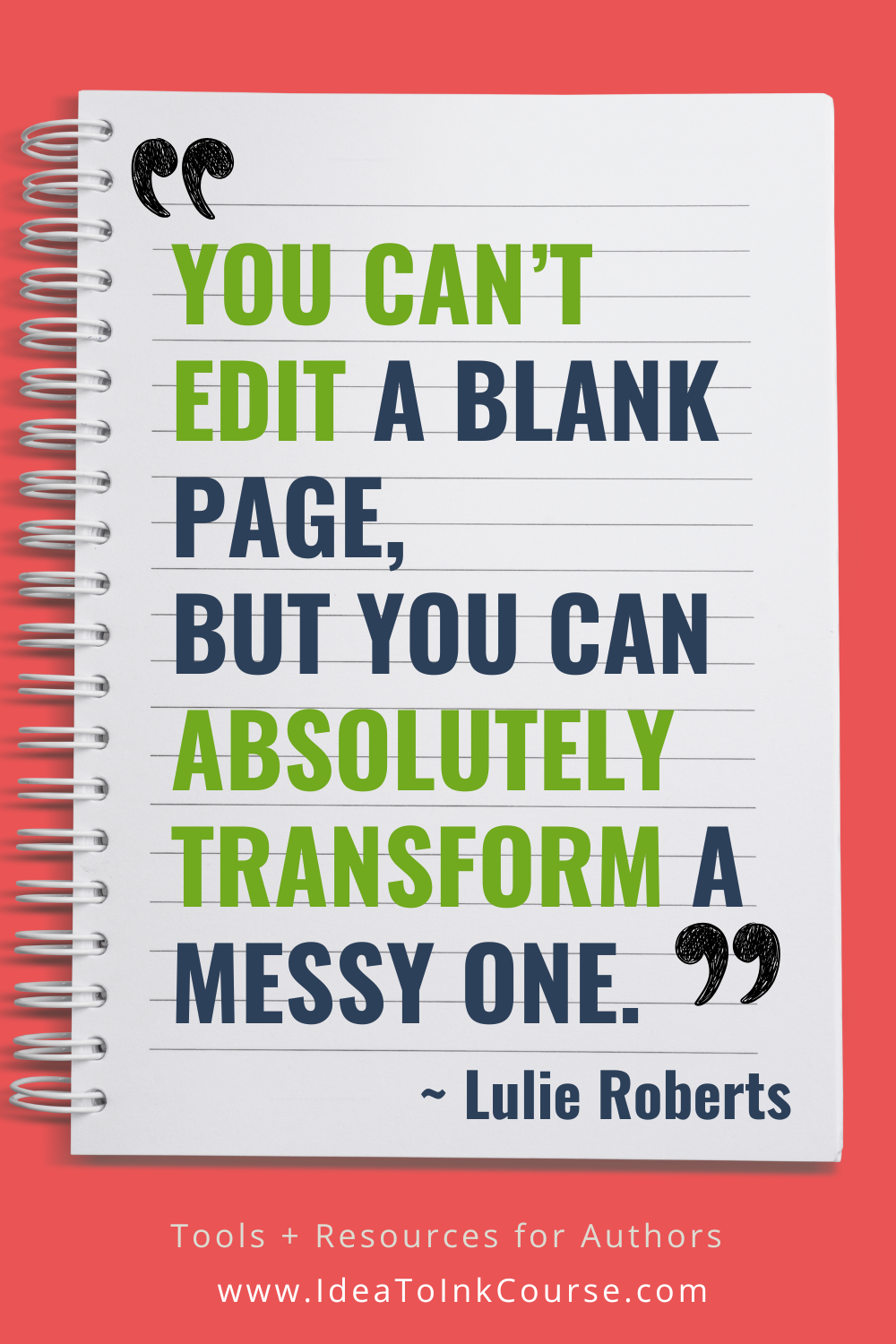
You can’t edit a blank page, but you can absolutely transform a messy one.
3) Imperfection is Liberating
Once you release yourself from the delusion that your first draft must impress the imaginary Pulitzer Prize board sitting on your shoulder, something astonishing happens:
You start writing freely.
You stop censoring yourself.
You stop worrying about what your high school English teacher would think.
You stop editing every sentence into oblivion.
Instead, you start telling your story the way it wants to be told—wild, unfiltered, and alive.
Allowing your draft to be bad is the creative equivalent of opening the window in a stuffy room. Suddenly, your ideas can actually begin to breathe.
How to Celebrate the Draft (Instead of Crying Over It)
Now that we’ve established that your first draft’s terrible nature is actually delightful, let’s talk about how to actively celebrate it.
Yes, actually celebrate it. Applaud your chaos. Throw confetti over your plot holes. Toast the fact that your protagonist’s eye color changed three times in one chapter. This is all part of the process.
Let's bring some joy back into your writing process.
Throw a Mini Party at 10,000 words
You hit 10,000 words? That’s a huge accomplishment.
Throw a party!
Okay, so maybe not a full-blown gala with a live DJ and chocolate fountain (though if that’s within your budget, who am I to stop you?), but at least something small and celebratory. Take yourself out for dessert. Send an unprompted and sarcastic “I’m a literary genius” text to your best friend. Go for a jog around your block and high five a stranger.
These 10,000 words potentially include:
- Three chapters you’ll probably delete
- A conversation between two characters that sounds more like robots rehearsing lines than real people
- Five notes to yourself that simply say: “FIX THIS LATER”
It doesn’t matter. You did the hard thing. You wrote them. And that’s what matters.
Create a Ritual That Brings You Joy
Writing rituals don’t have to be elaborate. They just have to feel good.
Maybe you like to light your favorite scented candle. Maybe you prefer to write with a steaming cup of tea that you’ll inevitably forget to drink before it goes cold. Maybe you’ll blast your go-to motivational Spotify playlist.
Whatever makes writing feel like an event (rather than a chore) embrace it.
Rituals train your brain to associate writing with something pleasurable. It’s not about discipline; it’s about delight.
Reward Progress, Not Perfection
Did you finish a chapter?
Reward yourself.
Did you write three pages of dialogue that absolutely do not sound like an organic human conversation? Doesn’t matter, reward yourself.
Did you sit down and write even though you would’ve rather cleaned your entire house, organized your tax documents, or alphabetized your spice rack? Reward yourself.
Progress matters far more than perfection.
You are building habit, momentum, and (most importantly) your confidence: all the things that actually lead to a finished book. Celebrate every small step, even if it’s two steps forward and one step back.
The Truth
Let’s sprinkle in some honesty with a dash of sarcasm.
Waiting for Your First Draft to Be “Good”? Good Luck.
Hoping for a first draft to be perfect before you even begin to write is like waiting for clowns to be subtle. It’s simply not happening.
Clowns exist to be loud, ridiculous, and impossible to ignore. Same goes for first drafts. The sooner you accept this, the sooner you can get on with the messy work of creating something real.
Editing Is Where the Real Magic Happens
Editing is where you:
- Untangle the messy plot threads
- Strengthen your characters’ voices
- Fix your timelines (which currently make no sense)
- Turn your dialogue from robotic monotony into actual conversation
- Shape your clay into something worthy of admiration
Drafting is chaos. Editing is metamorphic.
Trying to make your first draft perfect is like trying to paint a masterpiece without ever touching the brush—it’s messy before it becomes art.
Feeling Embarrassed About Your First Draft?
You know who gets embarrassed about their first draft?
Writers, that’s who. Real, honest-to-goodness writers.
If you look at your draft and feel a mix of horror, pride, and confusion... congratulations: you’ve joined the club. Not even the writers whose books you binge-read in a single night got it right the first time.
Every stumble, strange sentence, and rough patch in your draft is an essential part of something amazing taking form.
The Final Takeaway: Celebrate the Glittery Mess
Your first draft isn’t a polished gem.
It’s not supposed to be.
It’s supposed to be:
- A glittery mess
- A creative explosion
- A storm of ideas
- A rough sketch
- A stepping stone
- A sign that your imagination is alive
- Proof that you showed up
- Evidence of your courage
Messy drafts are invitations to keep going. They’re declarations that you dared to begin.
Laugh at your first draft. Roll your eyes at it. Admire its audacity. Celebrate the fact that it exists. Because the only truly bad draft is the one you never got around to writing.
Your story deserves to live in the world—and it starts with the wonderfully imperfect chaos you create today.
Ready to write your book?
Download the Essential Book Writing Templates for FREE and start strong.
We think SPAM is icky. We will never sell your information, and you can unsubscribe at any time.